
The RCA SJT400: A $323 Ticket to the Format War Nobody Won
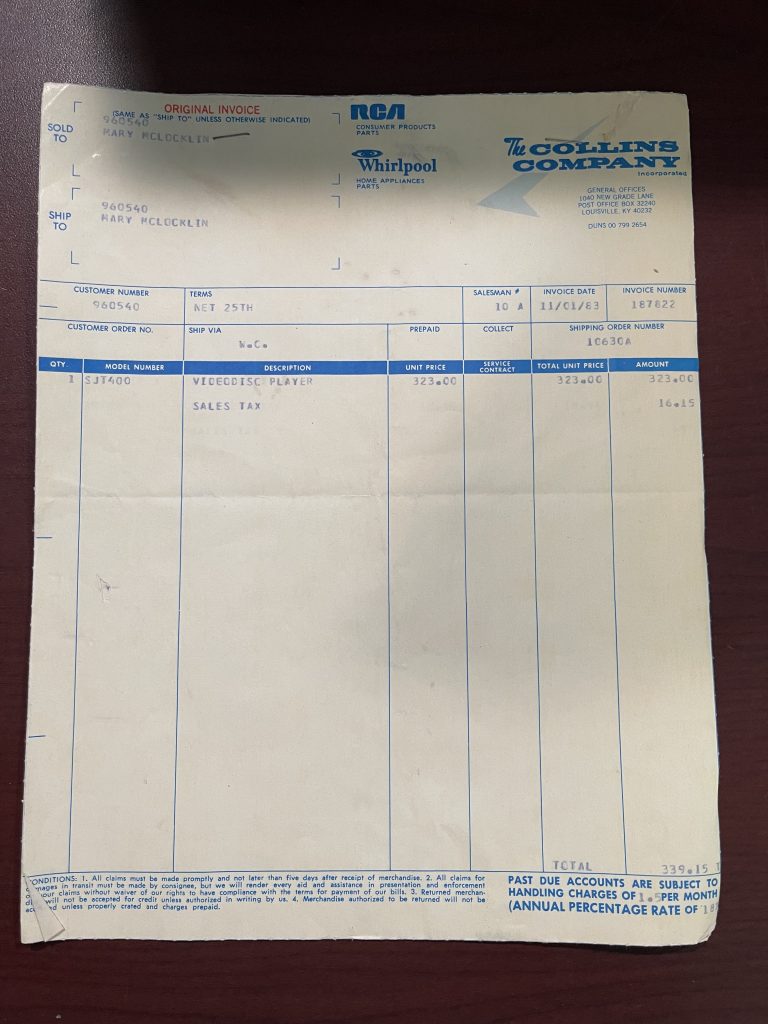
It’s November 1, 1983. Mary McClocklin walks into The Collins Company in Louisville, Kentucky, hands over $339.15, and walks out with an RCA SJT400 Videodisc Player. The invoice — printed on letterhead featuring both RCA Consumer Products Parts and Whirlpool Home Appliances Parts, a reminder of how different the distribution world once looked — is a perfect time capsule. Five months later, RCA will announce it’s abandoning the entire format.
Mary may not have known she was buying a dead format walking. But that receipt, and the machine behind it, tell one of the most fascinating stories in consumer electronics history.
What Is a CED Player, Anyway?
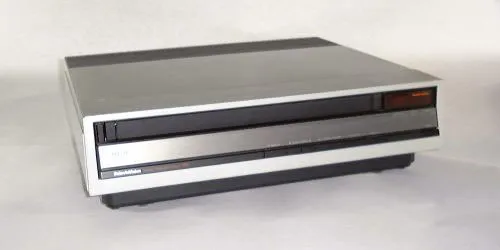
The RCA SJT400 is a CED player — Capacitance Electronic Disc. Don’t let the sleek silver chassis fool you into thinking “laser.” There’s no laser inside. Instead, the SelectaVision system works more like a vinyl record player than a DVD player: a diamond-tipped stylus physically rides in microscopic grooves on a PVC disc, reading capacitance variations in the groove walls to reconstruct audio and video signals.
It sounds almost absurdly analog for something marketed as futuristic home video technology. And in a sense, it was. RCA had been developing the CED format since the late 1960s, and by the time it launched in 1981, the world had moved on in ways RCA hadn’t fully accounted for.
The discs themselves were sealed inside plastic caddies — you slid the whole caddy into the player, and the machine pulled the disc out internally. You never actually touched the disc. It was a clever solution to the stylus-contamination problem, but it also meant the format was completely proprietary and visually unlike anything else on the market.
The SJT400: Mid-Range, Feature-Rich, Doomed
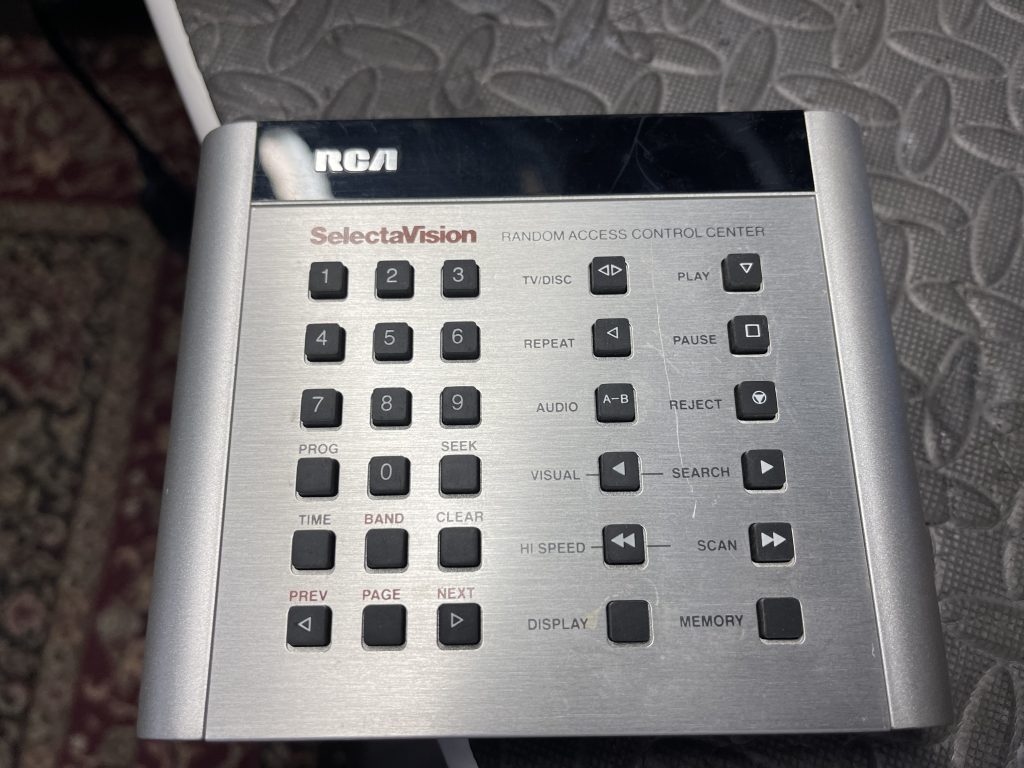
The SJT400 sat in the middle of RCA’s CED lineup — not the entry-level unit, not the flagship. At $323 (roughly $1,000 in today’s dollars), it offered a compelling feature set for the era, including the Random Access Control Center remote — a beefy, brushed-aluminum wired remote that looks more like a calculator than a TV remote.
That remote is a marvel of 1983 UI design. It features a numeric keypad for jumping directly to any chapter, dedicated buttons for PLAY, PAUSE, REJECT, and SEARCH, and functions like VISUAL SEARCH, HI SPEED SCAN, and MEMORY. For a home video format, this was genuinely sophisticated random-access capability — something VHS couldn’t match at the time.
The player itself is elegantly understated: a wide, low-profile silver-and-black box with a front-loading caddy slot. It looks like it belongs in a 1983 living room alongside a component stereo system, which is exactly where RCA imagined it.
Playing Thriller in 1983
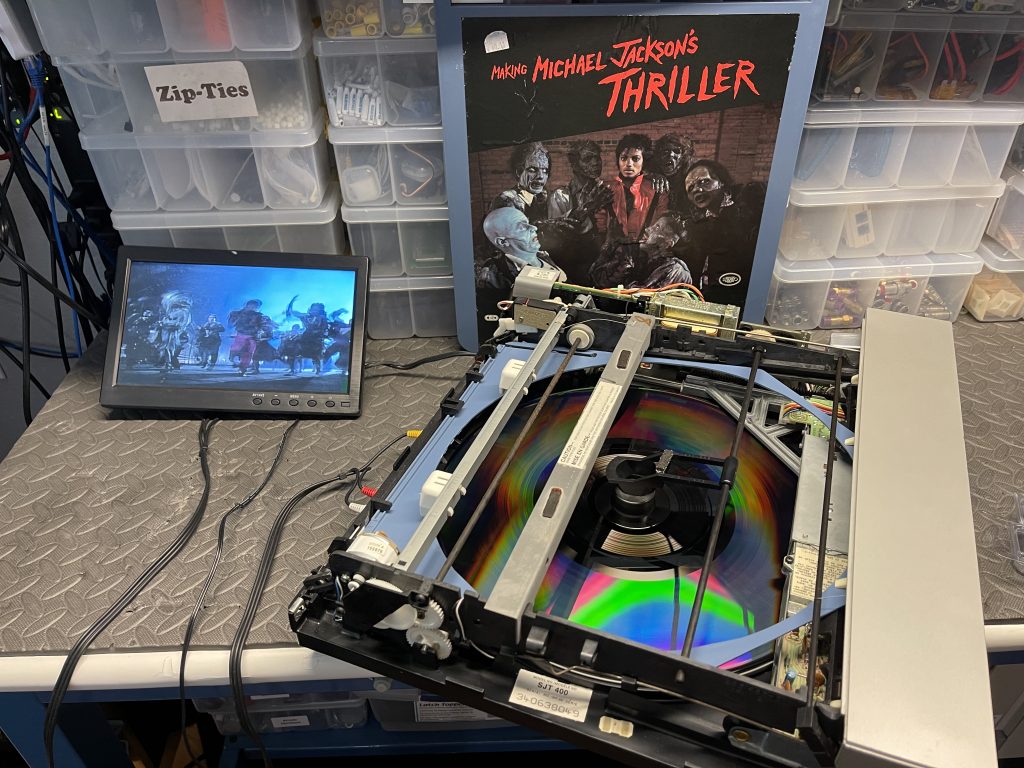
Here’s where the SJT400 gets poetic. Pop open the top of one of these machines and you see the engineering in all its naked glory: the tone arm assembly, the capstan drive, the disc spinning under a stylus at 450 RPM for CAV discs (or 900 RPM for CLV — the player automatically handles both). The rainbow shimmer of the PVC disc under workshop lighting is genuinely beautiful.
Now put on Making Michael Jackson’s Thriller — a title released on SelectaVision VideoDisc — and that little monitor lights up with the zombie-dance sequence from one of the most iconic music videos ever made. It’s 1983 content on 1983 hardware, and it still works. That’s remarkable.
The “SelectaVision VideoDisc Presentation” title card that preceded content on CED releases is one of those small details that feels instantly nostalgic to anyone who grew up with the format — a brief flash of colored vertical bars and confident typography before the feature begins.
Why It Failed
RCA lost an estimated $580 million on the SelectaVision CED format before pulling the plug in April 1984. The reasons are layered:
VHS won the living room. By 1983, VHS VCRs weren’t just players — they could record. The CED format was playback-only. Consumers who could afford either chose the flexibility of recording their own content.
LaserDisc beat it on quality. Pioneer’s LaserDisc format used an optical laser to read a 12-inch disc without physical contact, delivering superior picture and sound with no stylus wear. CED was cheaper, but audiophiles and videophiles gravitated toward LaserDisc.
Development took too long. RCA began serious CED development in the late 1960s. By the time it launched in 1981, a decade of delays meant the competitive landscape had completely shifted. The format that might have dominated the 1970s arrived to fight a 1980s battle.
The stylus wore out. Unlike optical formats, the CED stylus made physical contact with the disc and degraded with use. A new stylus cost money, required user replacement, and reminded consumers that this technology had more in common with their turntable than with the future.
The Legacy
The SJT400 and its siblings sold roughly 500,000 units over the format’s three-year commercial life. Thousands of CED titles were released, spanning Hollywood films, concerts, sports, and special-interest content. Today, working CED players are increasingly rare — the stylus mechanism is finicky, belts decay, and finding replacement parts requires a dedicated collector community.
But people do still restore them. They still spin discs. And that original invoice — customer number 960540, terms NET 25TH, salesman #10A, invoice #187822, November 1, 1983 — is a reminder that someone once stood at a counter and believed in this machine enough to spend a week’s wages on it.
Mary McClocklin got five months of use before RCA walked away from the format. Whether she knew it or not, she was part of one of consumer electronics’ great tragic chapters: a genuinely innovative technology that arrived just a little too late, cost just a little too much to develop, and faced competitors who had figured out that the future of home video wasn’t just about watching — it was about recording, too.
The SJT400 didn’t win. But forty-plus years later, it still plays Thriller (after I replaced the belts). That counts for something.